
The 2026 Checklist for Selecting Residential Home Builders in NYC
- ArGetsBuckets -
- Jul 8
- 12 min read

What if the most significant threat to your Manhattan renovation isn't a supply chain delay, but a digital signature that never arrived? With the January 2026 DOB attestation requirements now in full effect for Co-ops and Condos, the margin for administrative error has vanished. You understand that in the realm of luxury residential construction nyc, technical mastery is only half the battle. The other half is navigating a regulatory environment where a single missed sidewalk shed renewal or a non-compliant electrical load calculation can trigger an immediate stop-work order.
It's natural to feel a sense of anxiety regarding Co-op board scrutiny or the hidden costs of the city's new electrification mandates. You need more than a contractor; you require a boutique authority who takes total ownership of the result. This article provides a definitive vetting framework designed to help you identify builders who offer architectural-grade precision and predictable timelines. We will explore how to verify a firm's mastery of the latest 2026 codes, including the new "one-job" rule for construction superintendents, ensuring your home remains a sanctuary rather than a source of regulatory stress.
Table of Contents
Navigating the High-Stakes World of NYC Residential Home Building
The 2026 landscape for Manhattan and Brooklyn real estate is defined by a paradox of high demand and extreme regulatory pressure. While New York is experiencing its largest building wave since 2008, with over 50 new high-rise towers currently in development, the luxury residential construction nyc sector faces unprecedented volatility. Supply chain shifts, labor scarcity, and the mandatory transition to all-electric systems for new low-rise builds have raised the stakes for every homeowner. In this environment, high-end finishes are no longer enough to guarantee a successful outcome. Accountability has become the true differentiator. You don't just need a builder who can source rare materials; you need a partner who can manage the liability of a complex urban project.
Luxury is the baseline. Accountability is the result. This shift has redefined the role of the boutique residential builder. We no longer view ourselves as mere executors of a set of plans. Instead, we act as premium project partners who bridge the gap between high-concept design and administrative compliance. The trend toward full-service, design-build integration is a direct response to the city's increasing complexity. By integrating the technical mastery of specialized trades with meticulous project management, we eliminate the friction that typically derails high-end renovations.
The Complexity of the NYC Urban Environment
Executing a high-end build within the city's architecturally significant buildings requires a deep understanding of historical structural systems. Whether you're renovating a pre-war penthouse or a landmarked townhouse, the friction between architectural vision and structural reality is constant. Success depends on senior-level oversight on every job site. It's about having an expert present who can identify a potential DOB violation before the first wall is opened. We prioritize management precision to ensure that heritage details are preserved while modern infrastructure is seamlessly integrated. This level of scrutiny is essential to avoid the stop-work orders that have become increasingly common under the 2026 DOB filing requirements.
Why a Single Point of Contact is Non-Negotiable
Fragmentation is the enemy of quality. When architects, designers, and trades operate in silos, the result is often a blame game that leads to delays and hidden costs. A single point of contact simplifies the process. It ensures that the person responsible for your kitchen remodelling is the same person overseeing the structural integrity of the entire unit. This centralized management model prevents communication gaps and provides architecture-grade project management. You gain a partner who takes full ownership of the timeline, the budget, and the final aesthetic. It's a methodical approach that transforms a stressful renovation into a logical, predictable progression toward your vision.
The Ultimate Selection Checklist for Luxury Builders
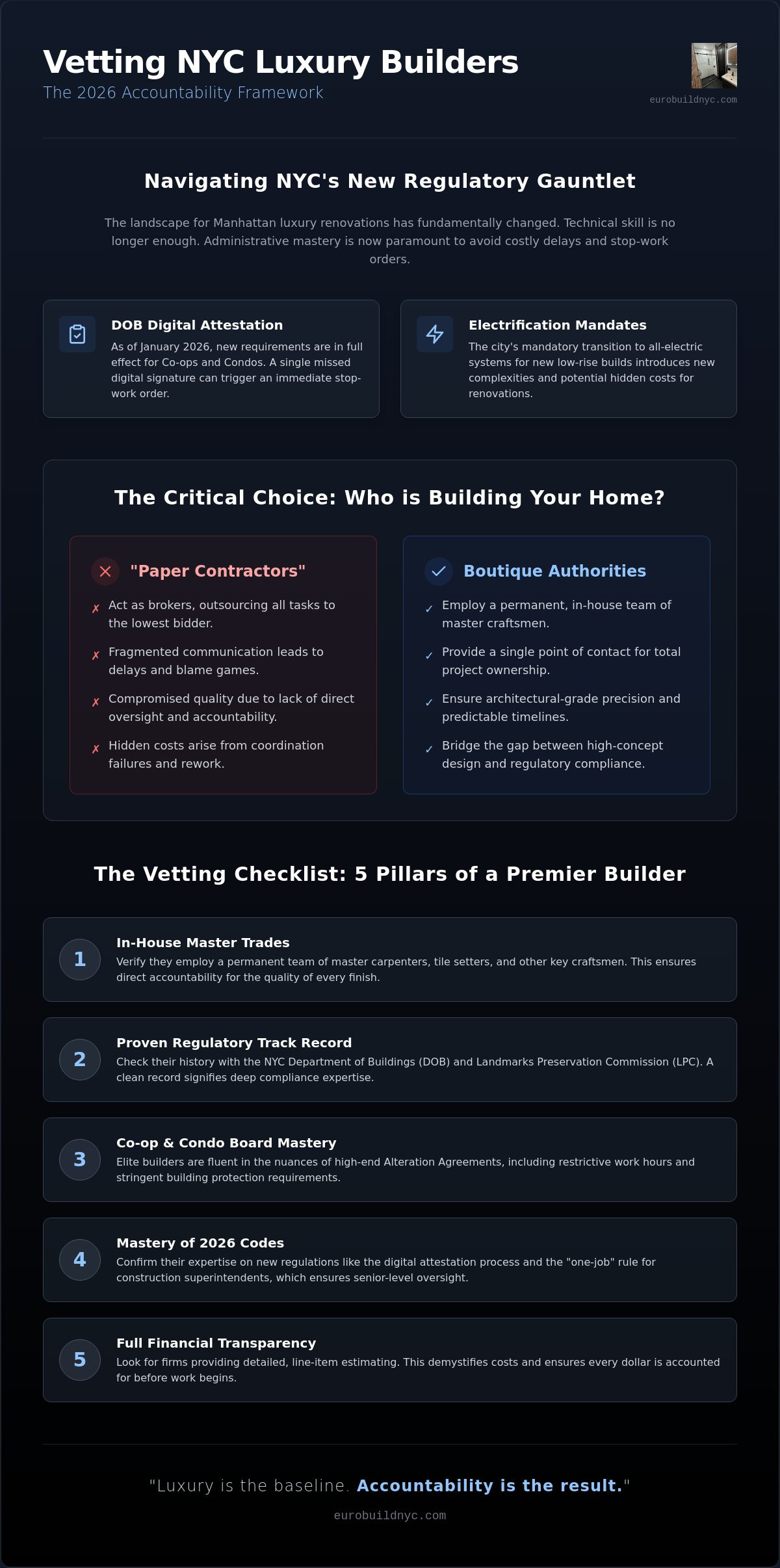
Distinguishing an elite builder from a standard contractor requires a rigorous vetting framework that goes beyond aesthetic portfolios. The NYC market is currently saturated with "paper contractors"-firms that act as brokers, outsourcing every task to the lowest bidder. This model often results in fragmented communication and compromised quality. To protect your investment, you must verify that your builder employs a permanent, in-house team of master craftsmen. This direct employment model ensures that the master carpenters and tile setters on your job site are accountable to the firm's high standards, not just a temporary subcontract. When evaluating luxury residential construction nyc, look for firms that provide transparency through detailed line-item estimating. This approach demystifies the luxury home renovation cost NYC, ensuring every dollar is accounted for before the first hammer is swung.
Administrative mastery is just as critical as physical craftsmanship. An elite builder must demonstrate a proven track record with the NYC Department of Buildings (DOB) and the Landmarks Preservation Commission (LPC). They should be intimately familiar with the nuances of high-end Co-op and Condo board Alteration Agreements, which often include restrictive work hours and stringent protection requirements. Before signing a contract, you should check their disciplinary and voluntary surrender records to ensure they maintain a clean standing with city regulators. Furthermore, verify that their insurance coverage is sufficient for NYC high-rises, including robust General Liability and Umbrella policies that meet the specific demands of premier Manhattan buildings.
The Financial and Legal Vetting Process
Large-scale projects require a builder with significant financial stability and bonding capacity. Review their history of managing projects of similar scope and complexity. Ask for a detailed explanation of their approach to change orders and budget contingencies. A reliable partner provides a clear roadmap for financial management, ensuring that unforeseen structural issues don't lead to unchecked costs. When you are ready to move forward, a consultation with an accountable project partner can provide the clarity you need to begin your project with confidence.
Operational Readiness and Scheduling
In 2026, architectural-grade precision requires modern management tools. Evaluate the builder’s technology stack for project tracking and reporting. Do they provide real-time updates? Is there a dedicated project manager with the bandwidth to oversee your site daily? An elite builder also maintains a localized supply chain for premium materials, ensuring that rare stone or custom cabinetry arrives according to a predictable timeline, regardless of global logistical shifts.
Evaluating Craftsmanship: In-House Master Trades vs. Subcontracted Labor
The prevailing industry practice in luxury residential construction nyc is the "paper contractor" model. These firms operate as administrative brokers, managing a revolving door of subcontractors. While this reduces their overhead, it introduces significant risks to your project. Subcontracted labor often lacks the continuity required for complex, multi-phase renovations. When a builder relies on external crews, they lose direct control over the schedule and the quality of execution. In contrast, a firm with in-house master trades ensures that the same master craftsmen are on-site from demolition through the final punch list. This continuity is essential for meeting aggressive deadlines in the Manhattan market, where Co-op work windows are often restricted to narrow seasonal blocks.
On-site challenges are inevitable in historic NYC buildings. In-house teams facilitate immediate, real-time problem solving. A master carpenter who is a permanent employee doesn't need to wait for a subcontractor's boss to visit the site to make a decision. They possess the authority and technical mastery to adjust a cabinet scribe or a floor transition instantly. This agility keeps the project moving without sacrificing the architectural intent. It's a level of accountability that external labor simply cannot replicate.
The Standard for High-End Finishes
Architecture-grade finishes require precision that general labor cannot achieve. When executing custom millwork or intricate architectural woodwork, the tolerances are measured in fractions of a millimeter. Book-matched marble and specialized stone installations demand a meticulous eye for grain alignment and seam placement. We believe the final 5% of a project defines the entire luxury experience. It's the difference between a project that looks good in photos and one that feels perfect to the touch. This level of detail is only possible when craftsmen have a long-term commitment to the firm's reputation.
Accountability in Every Detail
Accountability extends to how a job site is managed daily. In-house teams maintain a higher standard of site cleanliness and safety, which is critical in high-occupancy luxury buildings. Beyond the immediate aesthetics, the specialized mastery of your trades directly impacts long-term home durability. Proper waterproofing behind a "wet-room" conversion or the correct grounding of a complex electrical system is a matter of technical integrity. Before hiring, start by Verifying a Builder's NYC License to ensure they meet the city's legal standards. Integrating luxury home renovation contractors NYC into the early design phase allows these craftsmen to provide feedback on buildability. This collaborative approach prevents costly revisions later and ensures the finished product is as structurally sound as it is visually stunning.
Vetting for Administrative and Regulatory Compliance
The administrative burden of luxury residential construction nyc has reached a historical peak in 2026. Technical mastery is no longer the sole requirement for a successful build; administrative precision is equally vital. As of January 1, 2026, the Department of Buildings (DOB) implemented the "One-Job Rule," requiring licensed Construction Superintendents to be designated on only one active permit at a time. This shift has created a shortage of qualified oversight. You must verify that your builder has a dedicated superintendent who will be physically present on your site, rather than one stretched across multiple projects. A boutique authority maintains a robust administrative team to manage these compliance hurdles, ensuring your project doesn't stall due to a lack of senior-level supervision.
Current regulations require meticulous attention to detail before a single wall is opened. Effective January 26, 2026, co-op and condo boards must digitally attest in the DOB NOW system that they have approved your renovation plans before a permit filing is even accepted. This change adds an estimated two to four weeks to the pre-construction timeline. Furthermore, all sidewalk shed permits, as of February 2, 2026, now expire every 90 days and require active renewal. Failure to manage these granular deadlines leads to stop-work orders and unnecessary friction with building management. Your builder must act as a meticulous project manager, mitigating neighbor relations by strictly adhering to noise ordinances and site protection protocols.
Navigating the Alteration Agreement
The Alteration Agreement is the governing document of your renovation. Common pitfalls often involve insurance requirements that exceed standard residential policies, such as specific umbrella limits for high-rise work. Management of site logistics is equally complex. We coordinate strictly with building staff regarding elevator bookings and debris removal to maintain a professional presence within the building. Secure your project's compliance with a consultation on NYC regulatory navigation to ensure your board approval process is handled with precision.
LPC and Historic Preservation
Renovating landmarked NYC townhouses introduces a secondary layer of scrutiny from the Landmarks Preservation Commission (LPC). The builder’s responsibility is to maintain historic architectural integrity while integrating modern infrastructure, such as the all-electric heating systems required for new low-rise construction as of January 2026. We work closely with experienced expediters to navigate the 2025 NYS Energy Conservation Construction Code, which implemented more stringent standards for building envelopes this year. This specialized knowledge ensures that your permit issuance is timely and your home remains compliant with the city's evolving carbon emission limits.
Partnering with a Boutique Authority for Seamless Execution
Interior Design & Building Inc operates on a singular premise: master craftsmanship must be matched by meticulous management. In the high-stakes world of luxury residential construction nyc, a builder who cannot manage a spreadsheet is as dangerous as one who cannot manage a chisel. We eliminate the unpredictability of the city's labor market by maintaining an elite roster of in-house trades. This ensures that your project is never at the mercy of a subcontractor's shifting priorities or a broker's lack of oversight. Our team provides the stability required to execute complex designs without the typical volatility of the New York construction scene.
Our single point of contact model provides you with a dedicated project partner who takes full ownership of the end-to-end process. This person acts as your advocate, your manager, and your master builder. We transform the renovation experience from a stressor into a curated journey. Every detail is handled. Every administrative hurdle is cleared. Every finish is perfected. It's a methodical approach that prioritizes your peace of mind as much as the physical outcome. You deserve a partner who values your time and investment with the same intensity as the physical craftsmanship.
Our Methodology: From Sketch to Inspection
Our methodology begins long before the first tool arrives on site. During the pre-construction phase, we plan for zero-delay delivery by identifying potential long-lead items and regulatory bottlenecks early. We anticipate the friction points of NYC building management to ensure a seamless start. Real-time reporting provides senior-level accountability on every square foot of your home. You receive transparent updates that reflect the actual progress of the build. The process concludes with a white-glove handover, ensuring that every system is operational and every surface meets our architecture-grade standards. We don't consider a project finished until the final inspection is cleared and your expectations are exceeded.
Commitment to Quality
We maintain a boutique scale intentionally. This ensures that your project receives our full attention and senior-level oversight. We don't just build; we curate. By leveraging our 2026 vendor network, we secure exclusive materials and finishes that define modern luxury. Our relationships with specialized trades and premium suppliers allow us to maintain a standard of excellence that larger firms often lose in the volume of their work. Whether you are embarking on an apartment renovation or a whole home renovation, our team is ready to execute with precision. Contact Interior Design & Building Inc to discuss your vision and experience the precision of a boutique authority.
Securing the Future of Your High-End Residence
The landscape of 2026 demands a builder who is as proficient with regulatory filings as they are with architectural finishes. Success in luxury residential construction nyc requires more than just an eye for aesthetics; it requires a partner who takes full ownership of the administrative and physical complexities of the city. You've seen why vetting for in-house master trades is essential for labor continuity and why senior-level oversight is non-negotiable for navigating the latest DOB digital attestation requirements. These elements are the foundation of a project that stays on schedule and within budget.
Prioritizing accountability and management precision allows you to eliminate the friction that often characterizes Manhattan renovations. You deserve a single point of contact who manages every detail from the initial design phase to the final white-glove inspection. Our team provides the master craftsmanship and administrative mastery needed to protect your investment and your peace of mind. Partner with NYC’s boutique authority for your next luxury renovation. We look forward to bringing your vision to life with the precision and reliability your home deserves.
Frequently Asked Questions
How do I know if a residential home builder is truly luxury?
A true luxury builder is defined by administrative mastery and architecture-grade precision. Beyond a polished portfolio, look for a firm that provides total project ownership, from navigating complex board approvals to employing permanent master craftsmen. They utilize detailed line-item estimating rather than vague allowances. This transparency ensures that every technical detail and high-end finish is accounted for before construction begins, reflecting a standard of excellence that standard contractors cannot match.
What is the difference between a general contractor and a design-build firm in NYC?
A design-build firm provides a single point of contact by integrating architectural vision with construction execution. While a general contractor typically executes plans provided by an external architect, a design-build partner takes full responsibility for the project's feasibility, timeline, and budget from the start. This model reduces communication fragmentation and ensures that luxury residential construction nyc projects remain cohesive, as the builder is involved in every design decision.
Does a luxury builder handle NYC DOB permits and Co-op board approvals?
Yes, an elite builder manages the entire administrative lifecycle, including NYC Department of Buildings permits and Co-op board Alteration Agreements. This includes navigating the 2026 digital attestation requirements and the new "One-Job Rule" for superintendents. They coordinate directly with building management and expediters to ensure all legal hurdles are cleared. This senior-level oversight prevents the delays that often occur when administrative tasks are left to the homeowner or external consultants.
Why is in-house labor better than subcontracting for high-end renovations?
In-house labor provides total quality control and labor continuity. Unlike "paper contractors" who broker work to external crews, firms with permanent master trades ensure that the same craftsmen are on-site daily. This leads to superior site cleanliness, real-time problem solving, and a higher standard of finish. Permanent employees are accountable to the firm's reputation, ensuring that specialized tasks like book-matched marble installation are executed with technical mastery.
How long does a typical gut renovation take in a Manhattan apartment?
A high-end gut renovation typically spans nine to twelve months, depending on the scope and building restrictions. This timeline accounts for the pre-construction phase, which now includes a two to four-week buffer for the 2026 DOB board attestation process. Complex structural changes or landmarked townhouse projects may extend this duration. A meticulous project manager will provide a predictable schedule that accounts for these regulatory shifts and building-specific work hours.
What insurance should I verify before hiring a builder for a NYC condo?
You must verify that the builder carries robust General Liability, Workers' Compensation, and Umbrella policies specifically rated for NYC high-rises. Many premier Manhattan buildings require umbrella limits that exceed standard residential coverage. Ensure the policy includes "Action Over" coverage to protect against specific New York labor law liabilities. Verifying these documents protects you from the significant financial risks associated with luxury residential construction nyc in high-density environments.
How do I check the references of a high-end residential builder?
Request a list of completed projects with similar scope and complexity to your own. Speak directly with past clients about the builder's administrative precision and their ability to maintain a predictable timeline. Ask specifically about how the builder handled unforeseen structural issues or Co-op board friction. These scenarios reveal a firm's true capacity for project ownership and their ability to act as a reassuring partner throughout the construction process.
Can a builder help with the early stages of architectural design?
A design-build partner is essential during the early stages to provide buildability feedback and preliminary budgeting. They help bridge the gap between high-level architectural concepts and the structural reality of historic NYC buildings. This early integration prevents costly revisions later and ensures that the design is fully compliant with the latest 2026 energy codes and electrification mandates. Their expert input ensures your vision is both stunning and technically feasible.


Comments